Learn about our mission, values, and the community we serve.
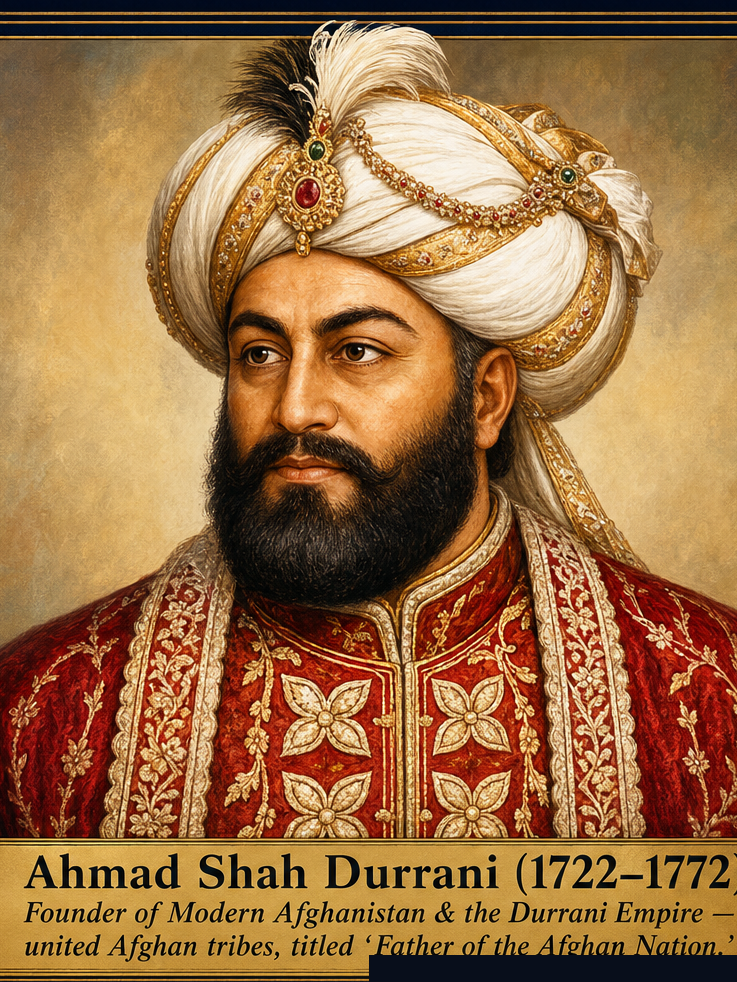
Ahmad Shah Abdali (Durrani)
1722 – 1772 | Father of the Afghan Nation
Born in Multan in 1722 to the Sadozai clan of the Abdali Pashtun tribe, Ahmad Shah rose from a young military commander in the army of Nader Shah of Persia to become one of the most consequential leaders in Central Asian history. After Nader Shah's assassination in 1747, the 25-year-old Ahmad Shah convened a loya jirga — a grand tribal council — in Kandahar. There, tribal elders and religious leaders from across the Afghan lands chose him as their king. A sprig of wheat was placed in his turban as a symbol of blessing, and he was given the title Durr-i-Durran — Pearl of Pearls — from which the Durrani Empire takes its name.
Within months of his coronation, Ahmad Shah began uniting the fragmented Afghan, Pashtun, and Central Asian tribes under a single sovereign state — an achievement no ruler before him had managed to sustain. He established Kandahar as his first capital and later made Kabul a center of governance and culture. His empire at its height stretched from eastern Persia to northern India, and from the Amu Darya river in the north to the Arabian Sea in the south, encompassing present-day Afghanistan, Pakistan, northeastern Iran, and parts of India and Central Asia.
His most celebrated military victory came at the Third Battle of Panipat in 1761, where his forces decisively defeated the Maratha Confederacy — then one of the most powerful empires in South Asia — halting their northward expansion and reshaping the balance of power across the subcontinent. Ahmad Shah fought more than a dozen major campaigns across his lifetime and was never defeated on the battlefield.
Beyond conquest, Ahmad Shah was a poet of considerable reputation, composing verse in Pashto under the pen name Seeking (درد). He patronized scholars, poets, and artisans, and his court at Kandahar attracted intellectual and artistic talent from across the Islamic world. He was known for his personal humility, his accessibility to ordinary people, and his deep respect for Islamic values and tribal tradition.
Ahmad Shah Abdali died in 1772 near Kandahar, leaving behind a unified Afghan nation where none had formally existed before. His legacy endures in the very idea of Afghanistan as a homeland — a place where diverse tribes, languages, and traditions share a common identity and a common destiny. He is commemorated on the Afghan currency, celebrated in poetry and song, and honored across centuries as the Baba — the Father — of the Afghan Nation.
Afghan Diaspora Center (ADC) is a national nonprofit organization founded by members of the Afghan diaspora to preserve, celebrate, and share the rich cultural heritage of Afghanistan. We serve communities across the United States through a growing network of local chapters — each rooted in its own city and region, each united by the same mission.
We believe that culture is a bridge — connecting generations, uniting communities, and building understanding between people of different backgrounds. Through our programs, events, and outreach, we work to keep Afghan traditions alive while welcoming all who wish to learn and participate.
Our local chapters — starting with the founding Gurbat Cultural Association (SF Bay Area) in California, Gurbat Cultural Association (DMV) in Washington D.C., Maryland, and Virginia, and Negaristan Farhanghi (Afghan Cultural and Literary Council) — are the living, breathing heart of everything we do. Each chapter knows its community intimately, organizes locally, and connects families on the ground. ADC provides the national framework, shared resources, and collective voice that makes every chapter stronger.
Our name, Gurbat, is drawn from two profound sources of meaning. It evokes the image of an eagle in full flight — a creature of great altitude, clarity, and fearless spirit. It also shares its name with a legendary mountain peak, celebrated for its commanding height and the sense of noble courage it inspires in all who look upon it. These two images — the soaring eagle and the unwavering summit — speak to the very soul of our community: people who carry their heritage with dignity, face challenges with resolve, and always aspire to greater heights.
We place the well-being and belonging of our community members at the center of everything we do.
We honor and preserve the traditions, language, arts, and history that define Afghan identity.
We welcome everyone — regardless of background — who shares a love for culture, community, and connection.
We invest in education, resources, and opportunities that help individuals and families thrive.
The story of Afghan Diaspora Center did not begin in a boardroom or with a formal charter. It began in living rooms, community halls, and local parks — wherever Afghan families gathered to celebrate Nowruz, share a meal, and hold on to the culture they carried with them across the world.
In the San Francisco Bay Area, a dedicated group of Afghan community leaders took the first deliberate steps toward something lasting. They began organizing cultural celebrations, launching Dari and Pashto language classes for children, and building outreach programs for newly arrived families across the Bay Area. It was here that the name Gurbat Cultural Association was first given form — rooted in the belief that Afghan identity, language, and heritage must be actively preserved, not simply remembered. The SF Bay Area chapter planted the seed from which the entire Gurbat movement would grow.
Around the same time, in the Washington D.C. metro area — home to one of the largest Afghan communities in the United States — a parallel movement was taking shape with equal conviction. Community leaders across D.C., Maryland, and Virginia were organizing cultural events, providing support for families navigating a new country, and building structures for advocacy and education. This effort became Gurbat Cultural Association (DMV), carrying the same spirit and the same name — two chapters, two coasts, one shared vision.
Both chapters were building something real: programs that worked, communities that showed up, and families that found belonging. But as they grew, their leaders began to see something larger taking shape. The challenges they faced — preserving language, supporting youth, advocating for Afghan families, funding programs, and maintaining connections to Afghanistan — were not unique to one city. They were shared across every Afghan community in America.
That shared recognition sparked a conversation between chapter leaders from both coasts. What if the work they were each doing locally could be connected, amplified, and sustained through a national organization? What if every Afghan community in America could have the same kind of support structure that had grown organically — first in California, and alongside it in the DMV — spreading from coast to coast?
From those conversations, Afghan Diaspora Center was born — a national nonprofit that gives every local chapter a shared identity, collective resources, and a unified voice, while preserving the local focus and personal relationships that make each chapter effective. ADC is not above its chapters; it exists because of them.
Today, we continue to expand our reach — building new chapters, deepening existing programs, and creating spaces where every Afghan family, wherever they are in America, feels seen, heard, and celebrated.
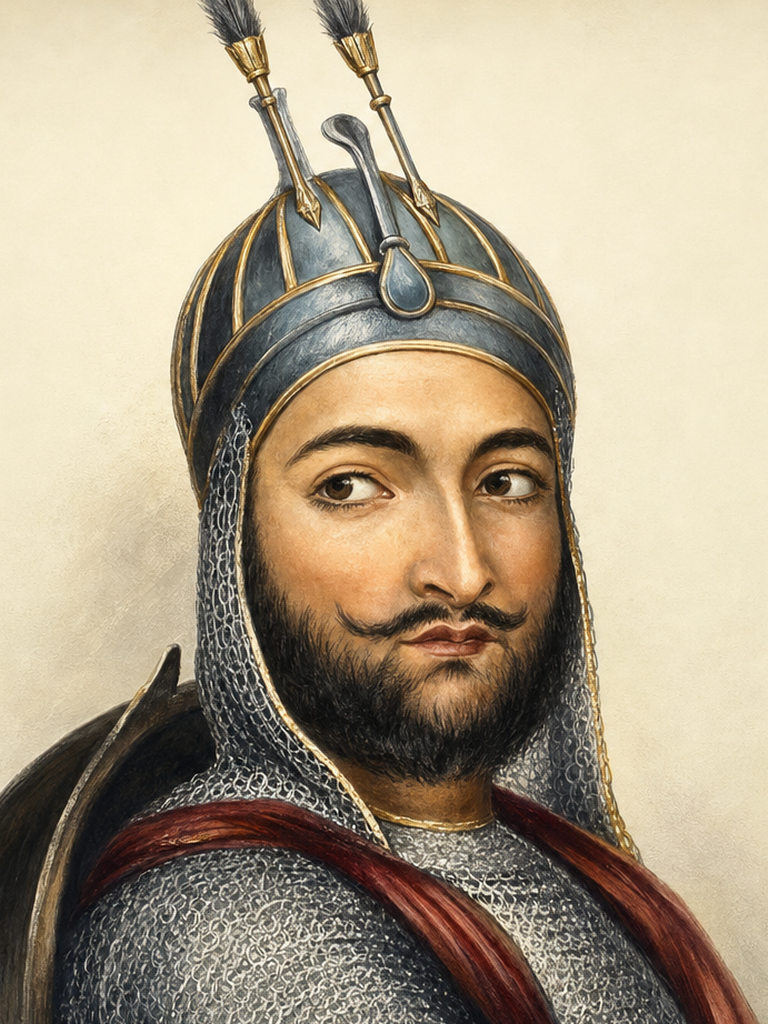
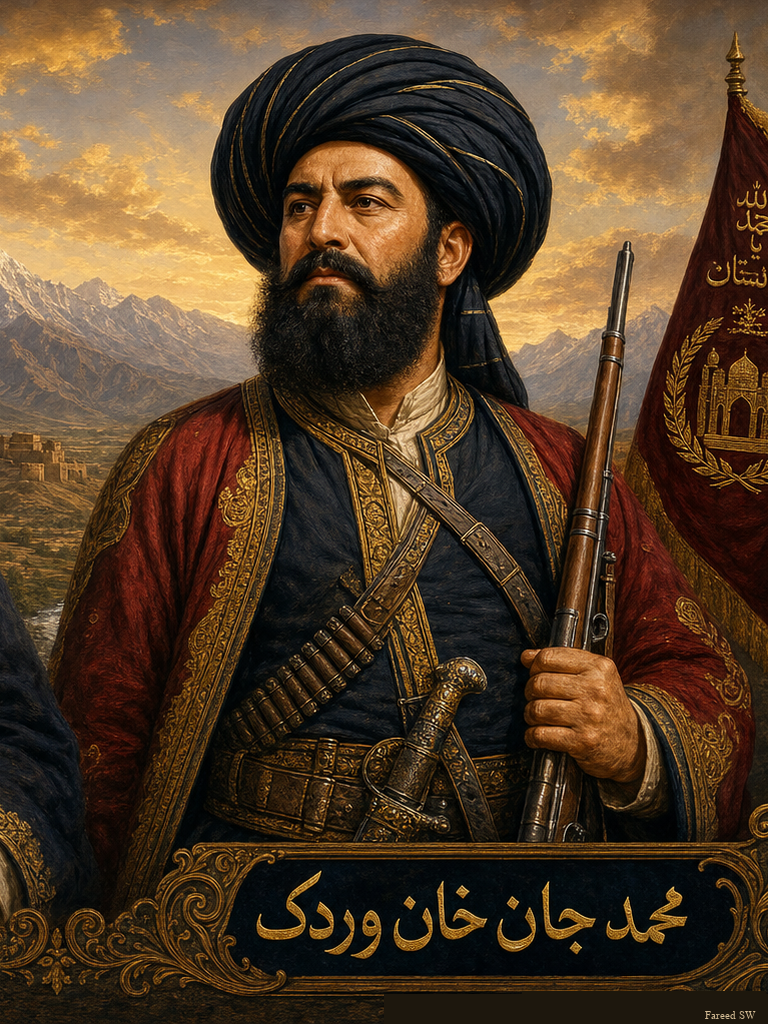
What began as grassroots gatherings in individual cities grew into structured chapters — and those chapters grew into a national organization. Here is how the movement unfolded.
Afghan families across the U.S. begin organizing informal Nowruz, Eid, and cultural celebrations — building neighborhood bonds and a sense of belonging far from home.
The founding chapter of Gurbat takes root in California — Dari and Pashto language classes, youth empowerment programs, and cultural preservation initiatives serving the growing Afghan communities across the San Francisco Bay Area.
Visit SF Bay Area Chapter →Inspired by the movement in California, community leaders in Washington D.C., Maryland, and Virginia formalize their own efforts — launching structured cultural events, family support programs, and advocacy initiatives for one of the largest Afghan communities in the country.
Visit DMV Chapter →Leaders from both chapters recognize a shared mission that transcends any single city. They unite under a national nonprofit — Afghan Diaspora Center — to amplify their collective work, support new chapters across America, and give the Afghan diaspora a unified national voice.
Serving one of the largest Afghan communities in the United States — cultural events, advocacy, family support, education programs, and youth initiatives across the D.C. metro area.
Explore DMV ChapterADC welcomes community leaders who want to start a new chapter in their city. We provide guidance, national network support, and shared resources to help you get started.
Inquire About Starting a Chapter
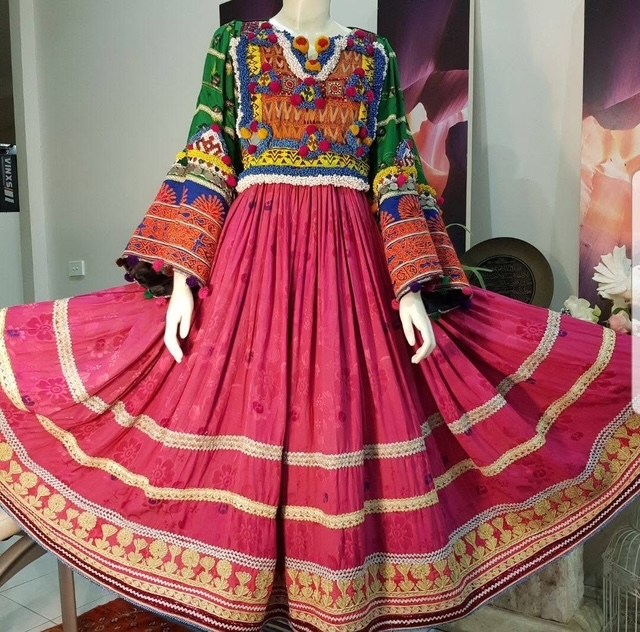
We organize annual festivals celebrating the full calendar of Afghan cultural occasions — from Nowruz (Afghan New Year) and Jashn (Independence Day) to seasonal gatherings and religious observances.
These events feature traditional Afghan music, dance, food, and storytelling. They are open to the broader public and serve as a bridge of understanding between Afghan and non-Afghan communities alike.
See Upcoming Events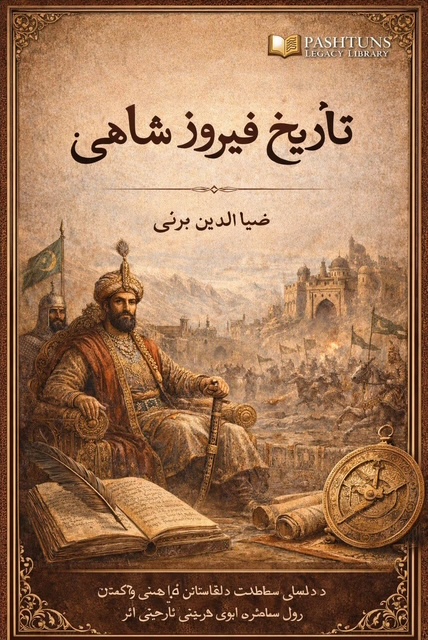
Our education initiatives include Dari and Pashto language classes for children and adults, workshops on Afghan history, literature, and arts, and after-school tutoring programs for Afghan youth.
We believe that language is the cornerstone of cultural identity. By keeping these languages alive in the diaspora, we help the next generation stay connected to their roots.
Enroll Now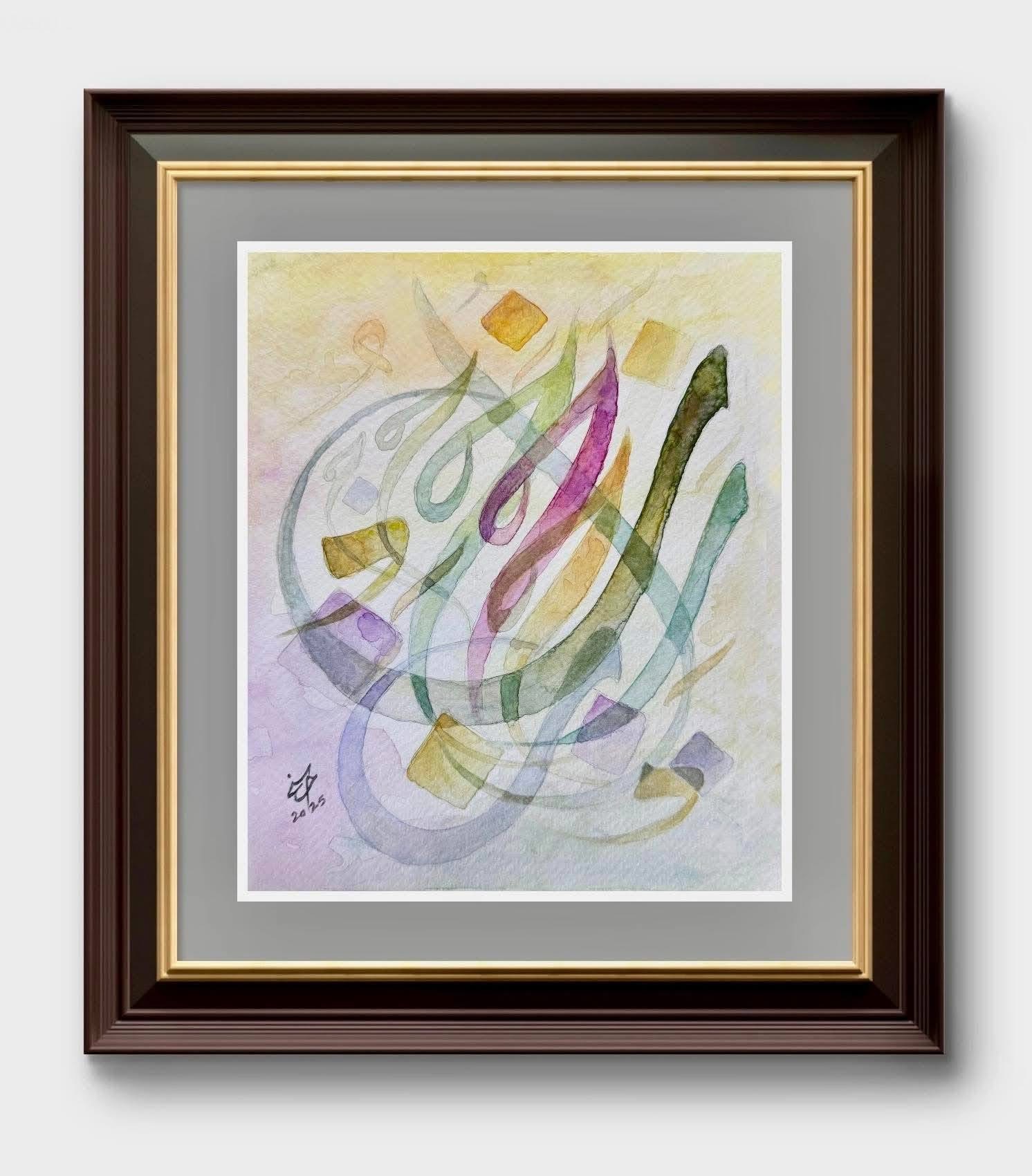
We provide critical support services for newly arrived Afghan refugees and immigrants — including resource navigation, legal referrals, housing assistance coordination, and community mentorship.
Our outreach team works directly with families to ensure they have access to the tools they need to build stable, fulfilling lives in their new home.
Request Support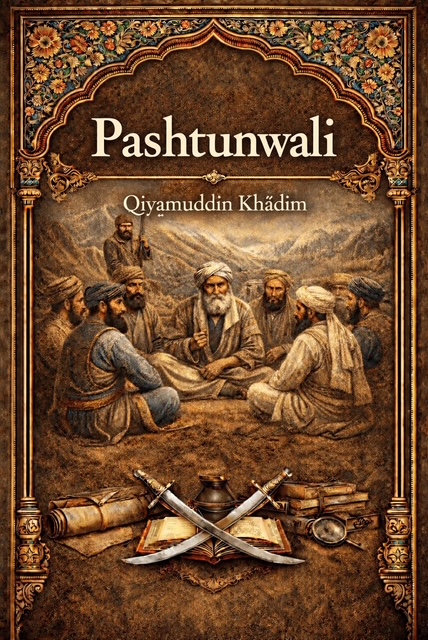
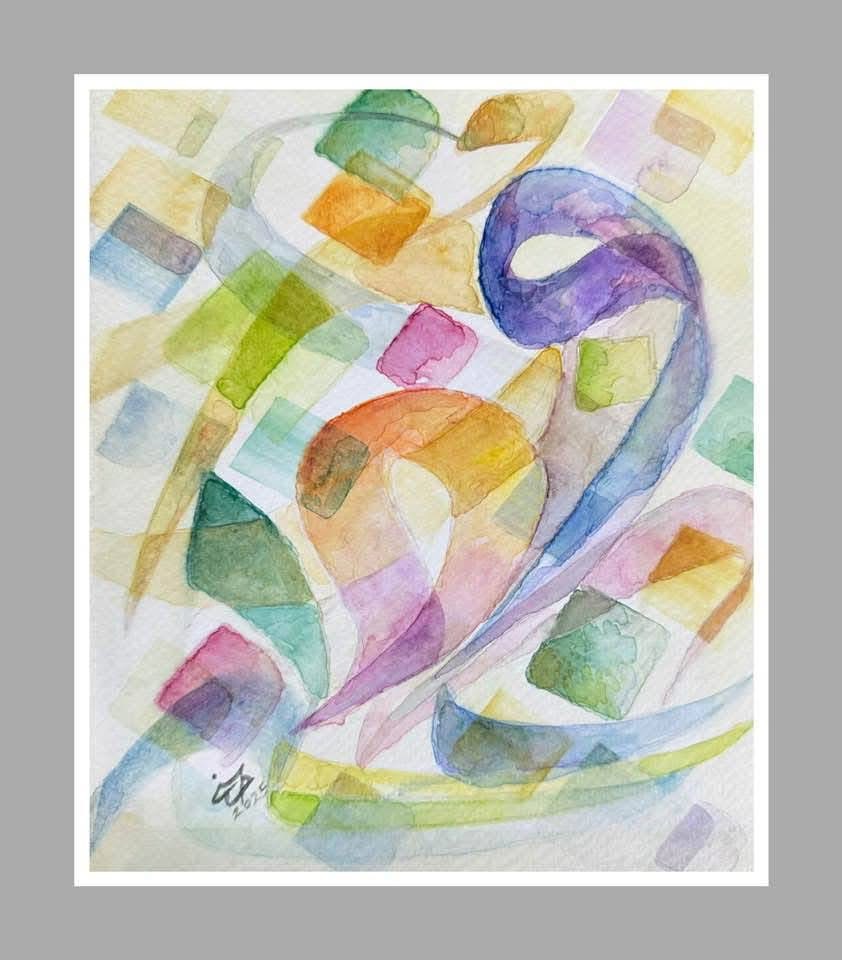
Afghanistan has a rich tradition of visual arts — from intricate miniature paintings and carpet weaving to calligraphy and poetry. Our arts program showcases Afghan artisans, hosts workshops, and curates exhibitions celebrating this heritage.
We also support Afghan poets, musicians, and visual artists within our community by providing platforms and resources to share their work.
Visit Gallery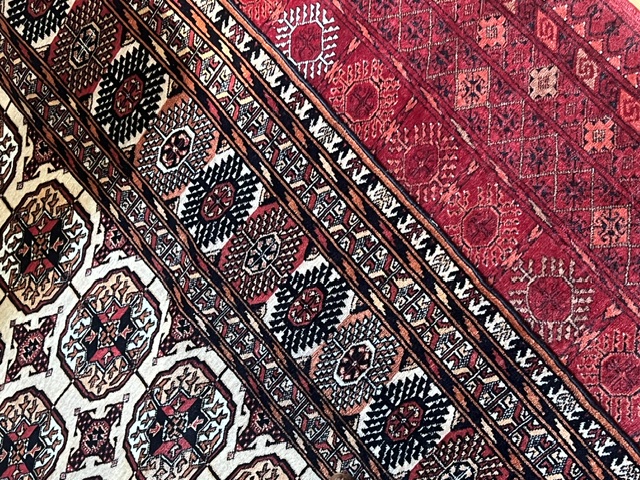
We are always looking for volunteers, supporters, and friends who share our passion for culture and community.